Greenwashing is everywhere in the cleaning aisle. Bottles covered in leaves, “natural” printed in green letters, vague claims about being “kinder to the planet” — none of it means much without real ingredients, real packaging changes, and real ethics behind it.
This guide cuts through that noise. Below are the 8 eco-friendly cleaning brands actually worth trusting in the UK in 2026, plus a breakdown of what “eco-friendly” should mean before you buy, and why cruelty-free matters just as much as the ingredient list. For a broader side-by-side of even more options, our companion piece on the 11 best eco-friendly cleaning brands in the UK (2026 edition) is worth a look too.
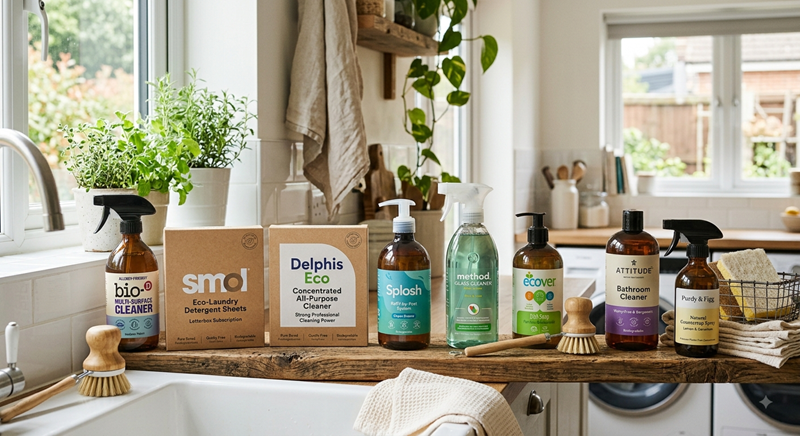
At a Glance: 8 Trusted Eco-Friendly Cleaning Brands (UK, 2026)
| Rank | Brand | Standout Strength |
| 1 | Ecover | Most widely available, longest track record |
| 2 | Bio-D | Best for allergies and sensitive skin |
| 3 | Delphis Eco | Strongest cleaning power for tough jobs |
| 4 | Smol | Best letterbox subscription model |
| 5 | Splosh | Best refill-by-post system |
| 6 | Method | Best-looking bottles, plant-based formulas |
| 7 | Attitude | Most transparent ingredient labelling |
| 8 | Purdy & Figg | Best premium, plastic-free option |
What Actually Makes a Cleaning Product “Eco-Friendly”?
The term gets used loosely, so it helps to break it into the specific things that need to be true at once:
- The ingredients break down safely. Biodegradable, plant- or mineral-derived formulas don’t linger in waterways or harm aquatic ecosystems the way synthetic chemicals can.
- The packaging isn’t adding to the plastic problem. Refill pouches, recycled materials, or reusable glass bottles matter as much as what’s inside them.
- Nothing harsh is hiding in the formula. Phosphates, chlorine bleach, ammonia, and synthetic fragrance are all red flags worth checking the label for.
- The manufacturing process holds up too. Renewable energy, local production, and reduced water content in concentrated formulas all lower the footprint before the product even reaches your home.
- It’s cruelty-free by default, not as an afterthought. Genuinely eco-conscious brands rarely separate environmental ethics from animal welfare — the two tend to go together.
A quick rule of thumb: if a brand can only point to one of these (usually the packaging, since it’s the most visible), it’s worth treating the “eco-friendly” label with some skepticism.
Why Cruelty-Free Should Be a Dealbreaker, Not a Bonus
It’s easy to assume “eco-friendly” and “cruelty-free” are the same claim. They’re not, and the gap between them is bigger than most shoppers realise.
- Animal testing on household cleaning products is still legal in plenty of markets, even in places where cosmetics testing bans exist. A brand can be “green” in every other sense and still fail this test.
- Certified cruelty-free brands are independently checked. Look for the Leaping Bunny or PETA Cruelty-Free logos — these require the brand to prove it, not just claim it.
- Cruelty-free formulas usually lean on gentler, plant-based ingredients, which is part of why they tend to overlap so heavily with genuinely eco-friendly products in the first place.
- It closes a loophole in your own values. There’s not much point choosing cruelty-free skincare or makeup while the products under your sink work against the same principle.
- Performance is no longer the trade-off it used to be. Brands like Delphis Eco and Bio-D show that cruelty-free, plant-based formulas can go head-to-head with conventional cleaners on tough jobs.
The 8 Best Eco-Friendly Cleaning Brands in the UK (2026)
1. Ecover
The brand most people think of first when “eco cleaning” comes up, and for good reason — Ecover has been formulating plant-based cleaners since the 1980s and is stocked in nearly every major UK supermarket. Its packaging increasingly uses recycled plastic, and its manufacturing runs on renewable energy. Why it’s here: The safest, easiest starting point for anyone new to eco cleaning.
2. Bio-D
Made in Manchester since 1989, Bio-D is built specifically with sensitive skin in mind — no SLS, no parabens, no synthetic fragrance. Its formulas are also concentrated, so a single bottle tends to outlast standard-sized alternatives. Why it’s here: The go-to pick for households dealing with eczema or skin reactions to regular cleaning products.
3. Delphis Eco
Used in hotels, restaurants, and commercial kitchens across the UK, Delphis Eco proves plant-based formulas can handle serious grease and grime without cutting corners. Its Heavy Duty Degreaser is fully vegan and biodegradable. Why it’s here: Proof that “eco” doesn’t have to mean “weaker.”
4. Smol
Smol rebuilt the laundry and dishwasher category around letterbox-sized refills instead of bulky plastic tubs, delivered by subscription. Formulas are designed to perform at 30°C, cutting energy use alongside plastic waste. Why it’s here: The simplest way to remove plastic tubs from your laundry routine without changing your habits.
5. Splosh
Founded in 2006, Splosh was doing refill-by-post before it was trendy. Concentrated refills arrive through your letterbox to top up reusable bottles you keep permanently at home — no repeat supermarket runs required. Why it’s here: One of the most complete plastic-reduction systems on this list.
6. Method
Method built its identity on design-forward bottles paired with genuinely plant-based formulas, and it remains one of the most recognisable names on UK supermarket shelves. Why it’s here: For anyone who wants their cleaning cupboard to look intentional, not just functional.
7. Attitude
Attitude has built a loyal following through full ingredient transparency — a rarity in this category — along with fragrance-free, hypoallergenic formulas that suit reactive skin and sensitive households. Why it’s here: If you want to know exactly what’s in the bottle, this is the brand that tells you.
8. Purdy & Figg
Sitting at the premium end of the market, Purdy & Figg uses refillable glass bottles and naturally derived formulas designed to double as shelf-worthy home decor. It costs more to start, but refills bring the cost down over time. Why it’s here: The pick for shoppers who want plastic-free cleaning without a utilitarian look.
Want to see how these stack up against a wider field of brands? Our related guide to the 10 best eco-friendly cleaning brands in the UK (2026 edition) covers additional options and pricing in more detail.
Frequently Asked Questions
How do I know if a cleaning brand is genuinely eco-friendly or just greenwashing?
Check for three things at once: biodegradable, plant-based ingredients; minimal or refillable packaging; and independent certification (EU Ecolabel, Leaping Bunny, or B Corp). A brand that only nails one of these — usually the packaging — is more likely greenwashing than genuinely sustainable.
Are eco-friendly cleaning products actually effective?
For everyday cleaning, yes — brands like Ecover, Bio-D, and Delphis Eco perform comparably to conventional cleaners. Very heavy grease or industrial-strength jobs may need a bit more effort, since eco formulas avoid the harshest synthetic solvents.
Is switching to eco-friendly cleaning products expensive?
Not usually. Concentrated and refill formats (Splosh, Smol) often cost less per use than repeatedly buying full-sized bottles. Premium brands like Purdy & Figg cost more initially but come down in price through refills.
What does “cruelty-free” mean on a cleaning product?
It means neither the finished product nor its individual ingredients were tested on animals. Look for a Leaping Bunny or PETA Cruelty-Free logo rather than relying on unverified claims printed by the brand itself.
Can eco-friendly laundry products work in cold water?
Yes — Smol and Bio-D are both formulated to clean effectively at 30°C, which reduces household energy use compared to the 40°C+ washes conventional detergents often need.
What ingredients should I avoid when choosing a cleaning product?
Phosphates, chlorine bleach, ammonia, synthetic fragrance, and SLS are the main ones to watch for. Certified eco brands typically replace these with plant-derived alternatives that are gentler on skin and waterways.
Small swaps add up. Pick one product category this week — laundry, surfaces, or washing-up — and replace it with a certified cruelty-free, eco-friendly option from this list.